Take Profit Orders for Options: Smarter Targets
Featured image: Take Profit Orders for Options: Smarter Targets
Options traders rarely lose money because they “didn’t know what they wanted.” They lose money because they couldn’t execute the exit they wanted when spreads widened, fills slowed down, or P&L moved faster than their workflow.
A take profit plan for options needs more than a target number. It needs a target that makes sense for Greeks, volatility, liquidity, and time, plus an order style that actually gets filled. This guide covers practical take profit orders for options and how to set smarter targets (especially for fast options trading and IBKR-style execution).
What is a take profit order for options?
A take profit order is an instruction to close an options position when it reaches a pre-defined profit level. In practice, it is usually a limit order to close (sell-to-close for longs, buy-to-close for shorts) placed at a specific premium.
It helps you:
- Lock gains without watching every tick
- Reduce decision stress in fast markets
- Avoid “round trips” where winners turn into losers
Important nuance: options are not stocks. Option premiums can move sharply due to delta, gamma, implied volatility (IV), and time decay, even if the underlying price barely changes. So “take profit at $X” can be too simplistic unless you pick $X using an options-aware method.
Why options take profit targets are harder than stock targets
With stocks, a take profit often maps cleanly to a price level. With options, you are trading a derivative whose price is influenced by multiple inputs.
Here are the main reasons take profit targets for options need extra thought:
The same underlying move can create different option P&L
A 1 percent move in the underlying can produce very different outcomes depending on:
- Time to expiration (gamma is usually higher near expiry)
- Strike selection (ATM vs OTM behaves differently)
- Implied volatility changes (IV crush after events can erase gains)
Liquidity and bid-ask spreads matter more
Many options contracts trade with wider spreads than stocks. If you set an optimistic limit price, you may never get filled. If you hit market in a thin chain, slippage can be brutal.
If you want a deeper execution framework, see Market Order vs Limit: When Speed Wins.
Time works for you or against you
For long premium, time decay is a headwind. For short premium, time decay is often a tailwind (but tail risk exists). Your take profit logic should reflect which side of theta you are on.
Smarter take profit targets for options (six practical frameworks)
A “smart” target is one you can defend mechanically. Below are six frameworks professional options traders commonly use. You can use one, or combine two (for example, premium percent + time stop).
1) Premium-based targets (percentage of option price)
This is the simplest method: take profit when the option premium reaches a percentage gain.
- Common for day trading liquid contracts where you want consistent rules
- Easy to automate and backtest
Watch-outs:
- Percent gains can be misleading on low-priced options (a 0.20 move on a 0.50 option is 40 percent)
- IV expansion can inflate premium temporarily, then fade
2) Underlying price level targets (technical levels)
Instead of targeting the option price, you target the underlying: prior high/low, VWAP, support/resistance, or a measured move.
This is useful when:
- Your thesis is primarily directional
- You want exits aligned with market structure
Watch-outs:
- Option premium may not map cleanly to the underlying move if IV changes
- Near expiry, gamma can cause P&L to accelerate, so you may need tighter execution discipline
3) Delta-based targets (exiting as your position “matures”)
Delta can be a clean way to express “how much of the move I’ve captured.” For long calls/puts, as your option moves ITM, delta often increases.
A delta-based take profit concept:
- Enter when delta is relatively low (more convexity)
- Scale or exit when delta becomes high (less convexity, more stock-like)
Watch-outs:
- Delta moves quickly near expiration (gamma risk)
- Requires you to monitor Greeks reliably
4) Volatility-aware targets (IV expansion and IV crush)
Options pricing is heavily influenced by IV. A volatility-aware take profit rule is often essential around catalysts.
Typical uses:
- Taking profits before earnings (to avoid post-event IV crush)
- Tightening targets when IV is elevated and mean reversion is likely
Watch-outs:
- You need a consistent way to judge “high IV” for that underlying (relative IV, IV rank, or your own historical bands)
- IV can expand further than expected before it reverts
5) Time-based exits (profit target plus a clock)
Time-based rules reduce the tendency to overstay.
Examples of time-aware take profit logic:
- “If target not hit by X time of day, reduce risk or flatten” (common for intraday)
- “If I am profitable by day Y, exit before theta or event risk changes”
Watch-outs:
- You can exit too early in strong trends
- You need consistency (time rules work best when applied uniformly)
6) Strategy-structure targets (spreads and short premium)
For multi-leg strategies, take profits are often defined by how much of the theoretical max profit you have captured.
A common professional convention:
- For credit spreads and other short premium structures, take profit well before max profit, because the last few dollars can carry disproportionate tail risk.
- For debit spreads, you may take profit when most of the spread’s intrinsic value is realized, especially if further upside is limited.
This is not a universal rule, but it is a widely used risk-reward framing.
Quick comparison table
| Take profit framework | Best for | What it measures | Main risk |
|---|---|---|---|
| Premium-based (%) | Fast directional trades | Option price change | IV noise, low-price distortion |
| Underlying level | Technical trading | Underlying reaching a level | Premium may lag if IV falls |
| Delta-based | Convexity capture | Position “maturity” | Gamma spikes near expiry |
| Volatility-aware | Event-driven trades | IV regime | IV can stay elevated |
| Time-based | Intraday, theta-sensitive | Time as a constraint | Exiting too early |
| Strategy-structure | Spreads, short premium | Captured edge vs max | Leaving money on table |
Take profit order mechanics (how to actually get filled)
A target is only useful if your order can execute in real market conditions.
Use limit logic that matches the chain’s liquidity
In liquid names, you may get away with tight limits near the mid. In thinner contracts, you often need to be more realistic.
Practical considerations:
- Bid-ask spread width: wide spreads require more conservative limits
- Displayed size: thin size means your fill may not happen at your price
- Time of day: open and close can be volatile, spreads can widen
Consider “marketable” limits for fast exits
If speed matters, many active traders use a limit priced to execute immediately (effectively paying the spread to reduce delay). This is a workflow choice: you trade some price for fill probability.
This becomes especially relevant in low latency options execution contexts where the edge comes from reacting quickly.
Partial exits can reduce regret
Instead of a single take profit, many pros scale out:
- First target locks a base hit
- Remaining size rides the move with a tighter rule
Scaling is not about being “right.” It is about managing the psychological and execution reality of options.
Order style table (conceptual)
| Exit order style | What it does | When it fits | Key downside |
|---|---|---|---|
| Limit take profit | Closes at your price or better | Most planned exits | May not fill |
| Market (or aggressive exit) | Prioritizes speed | Risk-off, fast reversals | Slippage in wide spreads |
| Bracket / OCO (TP + SL) | Automates both sides | Rule-based trading | Needs correct configuration |
| Trailing logic | Follows favorable moves | Trend days | Can get stopped on noise |
If you want a speed-first execution mindset, the checklist in Trading Execution: Cut Latency, Fill Faster is a strong companion.
Take profit guidance by common options strategy
Long calls and long puts (directional)
Directional longs benefit from convexity, but the trade can turn fast.
A practical approach is to pair:
- A premium-based or underlying-level take profit
- A time rule (do not let a short-dated contract bleed if the move stalls)
If you also need a stop framework tailored to options behavior, see Stop Loss Strategies for Options Traders.
Vertical spreads (debit and credit)
Spreads cap outcomes, so taking profits is often about risk efficiency.
- Debit spreads can be managed like “directional with a ceiling.” If most of the spread value is realized, remaining upside may not justify continued exposure.
- Credit spreads can be managed like “income with tail risk.” Many traders prefer to close once the incremental reward becomes small relative to adverse move risk.
Iron condors and other short premium ranges
Short premium range trades often look great until the range breaks.
A take profit plan should be linked to:
- How much premium you have captured
- Whether volatility is contracting as expected
- Whether the underlying is approaching a short strike (where risk accelerates)
Calendars and diagonals
These are sensitive to both IV term structure and time. Take profit plans often need a volatility-aware rule (for example, exit after IV normalization) plus a time rule.
Why automation matters (especially for fast options trading)
Manual exits break down when:
- You trade multiple chains or expirations
- You need to adjust quickly during volatility
- You are scalping and your edge depends on milliseconds and attention
The goal of automation is not to “set and forget.” It is to reduce execution friction so your plan is implemented consistently.
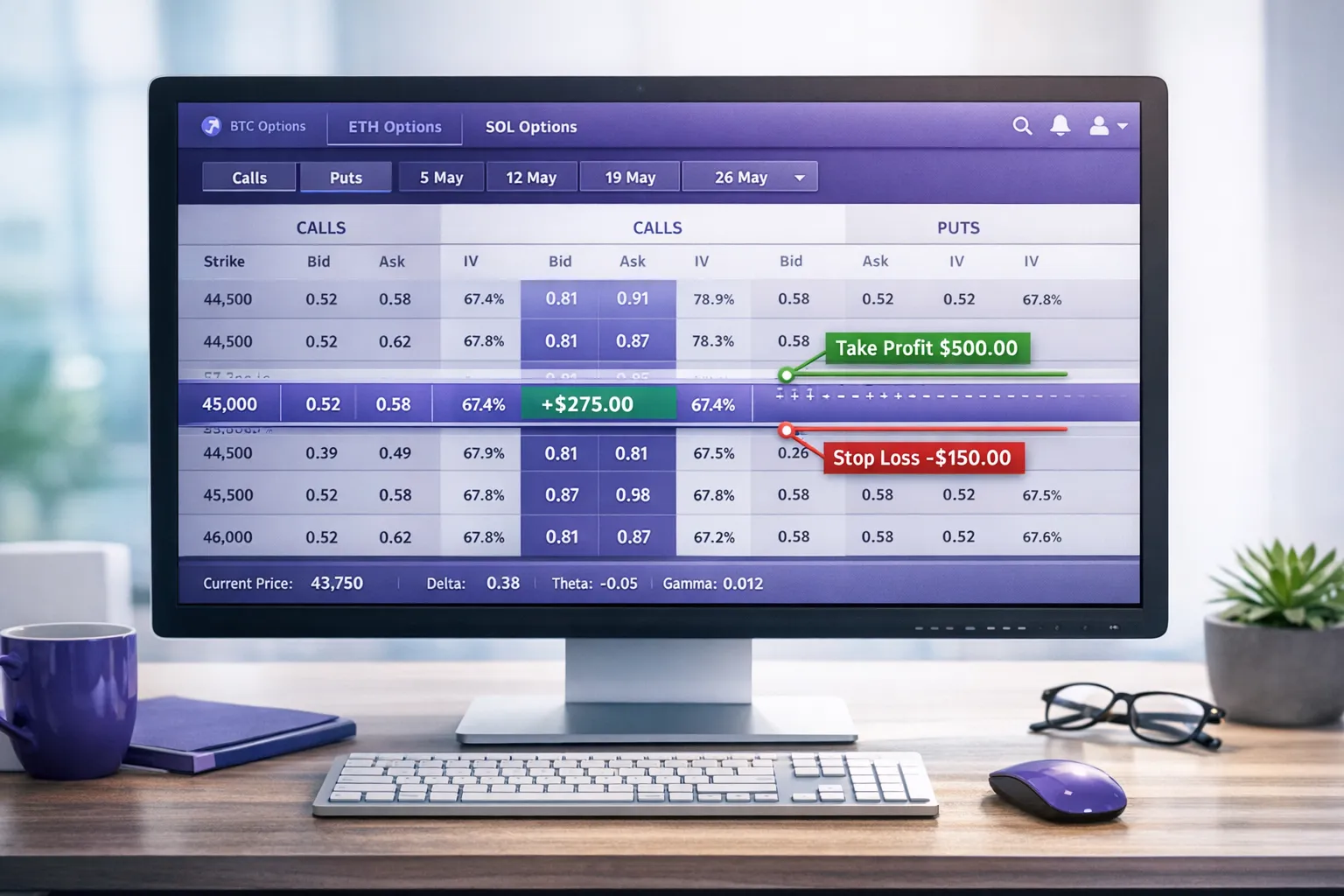
Where NeonChainX fits (IBKR-focused)
NeonChainX is a desktop options trading software built specifically for Interactive Brokers (IBKR options trading), with an emphasis on fast options trading and workflow clarity. If your take profit plan is sound but execution is slow or clunky, tools that reduce clicks and latency can matter.
NeonChainX is designed around:
- Direct integration with TWS / IB Gateway (no third-party intermediaries)
- Low latency trading focus (speed-first workflow)
- Multi-chain options view so you can see multiple expirations and strikes simultaneously
- One-click TP/SL automation so you can set exits without multi-step dialogs
- Real-time options P&L tracking per position
For a platform-specific walkthrough of setting automated TP/SL for options, read Take Profit and Stop Loss Configuration in NeonChainX.
Common mistakes with take profit orders for options
Setting targets without accounting for spreads
If the bid-ask is wide, your “profit price” might be theoretical. Targets should be chosen with fill reality in mind.
Ignoring volatility regime
A profit that exists due to IV expansion can vanish even if the underlying holds steady. Around catalysts, volatility-aware exits matter.
Letting winners turn into “hope trades”
Options punish hesitation because time and volatility can shift quickly. A take profit rule is primarily a behavioral tool.
Frequently Asked Questions
Do take profit orders work the same way for options as for stocks? They use similar order mechanics (often a limit order), but options pricing is influenced by IV, time decay, and Greeks, so the target selection needs to be options-aware.
What is the best take profit target for options? There is no single best target. Common approaches include premium-based percentage targets, underlying price levels, delta-based exits, volatility-aware exits, time-based rules, and strategy-structure targets for spreads.
Should I use market or limit orders for taking profit on options? Limit orders provide price control but may not fill. Faster exits often use more aggressive pricing (for example, marketable limits), especially in volatile conditions. Liquidity and spread width should guide the choice.
Can I automate take profit and stop loss for IBKR options trading? Yes, many traders use bracket-style logic or TP/SL rules. If you want a workflow designed for this, NeonChainX provides one-click TP/SL automation built for Interactive Brokers users (see the configuration guide linked above).
Why does my option hit my target but my take profit order does not fill? The most common causes are bid-ask spread width, insufficient liquidity at your limit price, rapid price movement, and using a limit that is not realistic relative to the current market.
Build exits you can execute
A smarter take profit plan for options is not just “pick a number.” It is:
- A target framework you can apply consistently
- An order approach that matches liquidity and urgency
- A workflow that lets you act fast when the window is open
If you trade options on Interactive Brokers and want a fast options trading platform for Interactive Brokers that reduces friction on exits, explore NeonChainX. To go deeper on automation, start with the practical walkthrough: Take Profit and Stop Loss Configuration in NeonChainX.