Back to Blog

Market Order vs Limit: When Speed Wins

Featured image: Market Order vs Limit: When Speed Wins

January 3, 2026

Lightning markets punish hesitation. In options, the choice between a market order and a limit order often decides whether you get filled at a sensible price or miss the trade entirely. For day traders, scalpers, and active Interactive Brokers users, understanding when speed should trump price control is a real edge.

This guide breaks down the difference in practical terms, shows where each order type excels, and outlines tactics to cap slippage without sacrificing fills. You will also see how NeonChainX helps you execute the playbook fast, with instant multi‑chain visibility and one‑click automation for take profit and stop loss.

Market vs limit in options, the realities that matter

Options are leveraged, they trade in increments, and every contract controls 100 shares. A 0.05 difference between your intended and actual fill is 5 dollars per contract. On a 50‑lot, that is 250 dollars in edge given up. Slippage compounds quickly, especially in weeklies and 0DTE.

  • Market order, prioritizes fill speed over price. The order will execute immediately at the best available price and may sweep multiple levels of liquidity if your size is larger than the displayed quote.
  • Limit order, prioritizes price over speed. You set the maximum price you are willing to pay to buy, or the minimum price you are willing to accept to sell. Execution is not guaranteed.

Options markets can be thin outside of top tickers and popular expirations. Spreads widen during the open, around news, and when volatility jumps. That is why the right order type is context dependent.

Order typeFill probabilityPrice certaintySlippage riskBest use casesCommon pitfalls
MarketVery high in liquid strikesLowHigher, especially in wide marketsFast exits, urgent hedges, small size in tight marketsBad fills in illiquid chains, opening prints, halted names
LimitConditional on your price, may be partialHighLower, bounded by your limitBuilding positions, multi‑leg trades, illiquid weekliesNon‑fills during fast moves, queue priority delays

Authoritative basics on order types are covered by regulators and exchanges. See FINRA’s overview of order types and trade‑offs and Interactive Brokers’ documentation on order types for platform specifics.

When speed wins: situations to prefer the market order

Speed is your edge when the cost of a miss is greater than the expected slippage. These are the classic cases for a market order.

1) Getting out of a broken trade

If the thesis changed, the headline hit, or the underlying just breached a hard level, the priority is exit. A few cents of slippage is cheaper than riding a momentum candle against you. Marketable exits shine here, especially for single‑leg positions in tight, high‑volume chains.

2) Urgent hedging during volatility spikes

When vol is expanding and delta is running away, buying protection or reducing exposure quickly matters more than shaving a few cents. For example, a day trader short shares might buy near‑term calls as a quick hedge when a squeeze begins. If the chain is liquid, a market order can secure the hedge before the next uptick.

3) Stop‑style automation that must fire

Stops that turn into immediate orders exist to cap risk, not to optimize price. If your risk plan relies on certainty of execution, use market or a marketable limit that is likely to fill. With NeonChainX, you can configure one‑click TP and SL automation and choose Market or Bid/Ask anchored pricing for triggered exits, so your plan executes without hesitation. Learn how to set this up in our guide: Take Profit and Stop Loss Configuration in NeonChainX.

4) Small size in very tight markets

On the most active names and expirations, where spreads are a penny or two and inside size is deep, the slippage cost is often negligible relative to the opportunity. In these cases, market orders can be an efficient way to enter or exit quickly.

Cautions even when speed wins:

  • Avoid pure market orders in the first minutes after the open, liquidity is uneven and spreads often flare.
  • Be mindful of news halts and reopenings, market orders into reopened options can print poorly.
  • Multi‑leg strategies are different, prefer priced combination orders instead of market to avoid legging risk on the net price.

When price control wins: prefer limit orders

1) Illiquid contracts and wide spreads

Weekly OTM options and thinly traded tickers can show 0.20 to 0.50 spreads or more. A market order here can hand over unacceptable edge. Use limits anchored to mid, and be willing to work the order in small improvements.

2) Multi‑leg spreads, butterflies, and calendars

Complex orders involve cross‑prices across legs. Use a net price limit so you control the all‑in debit or credit. Market orders on combos can expose you to legging risk and unpredictable net fills.

3) Building a position or scaling out

If you are not in a hurry, work a limit. Join the bid or offer, then step in a few cents if needed. Over a session, price improvement meaningfully boosts expectancy.

4) Around the open and into the close

The first 3 to 5 minutes after the open and some closing minutes can be noisy in options. Use limit orders to avoid bad prints when the underlying is gapping or auctions are resolving.

Hybrid tactics pros use to balance speed and control

You do not have to choose all or nothing. A few execution habits let you keep speed while bounding slippage.

Marketable limit orders

For buys, set your limit at or slightly above the ask. For sells, at or slightly below the bid. You get fast execution when liquidity is there, with a hard cap on worst‑case price. A simple rule is limit = inside price plus a fixed few cents or a fraction of the spread, whichever is greater.

Step the price, do not chase the print

Start near mid, then step quickly toward the inside if you do not get a fill in a few seconds. If you still miss during acceleration, switch to a marketable limit to complete the trade.

Size in clips

Break large orders into smaller tranches. You can often capture better average prices while still completing the idea quickly.

Automate exits, but choose the right type

For protective stops, use market or marketable limit. For take profits, use a limit anchored to your target. In NeonChainX, TP and SL rules let you pick Market, Bid/Ask, or Mid anchored orders, so your exit logic matches your intent. Details here: TP/SL risk management.

The math: how much does slippage really cost you?

A quick framework helps you decide when speed is worth it.

  • Contract multiplier, 100
  • Slippage per contract, Fill price minus reference price
  • Slippage cost, Slippage × 100 × number of contracts

Example: You planned to buy at 1.20, you got 1.24 using a market order. Slippage is 0.04, which is 4 dollars per contract. On 50 contracts, that is 200 dollars. If your average trade expectancy is 0.10 per contract, you just gave up 40 percent of your edge on this trade.

Flip side: You waited with a limit at 1.20, no fill, then the option prints 1.40 within 30 seconds. You lost 0.20 of opportunity, which is 20 dollars per contract. On urgent moves, the opportunity cost can exceed the expected slippage, which justifies speed.

A practical cutoff many active traders use, treat market or marketable limit as acceptable when the spread is tight relative to premium, for example 1 to 3 percent of the option price, and your size is well under the inside quote size.

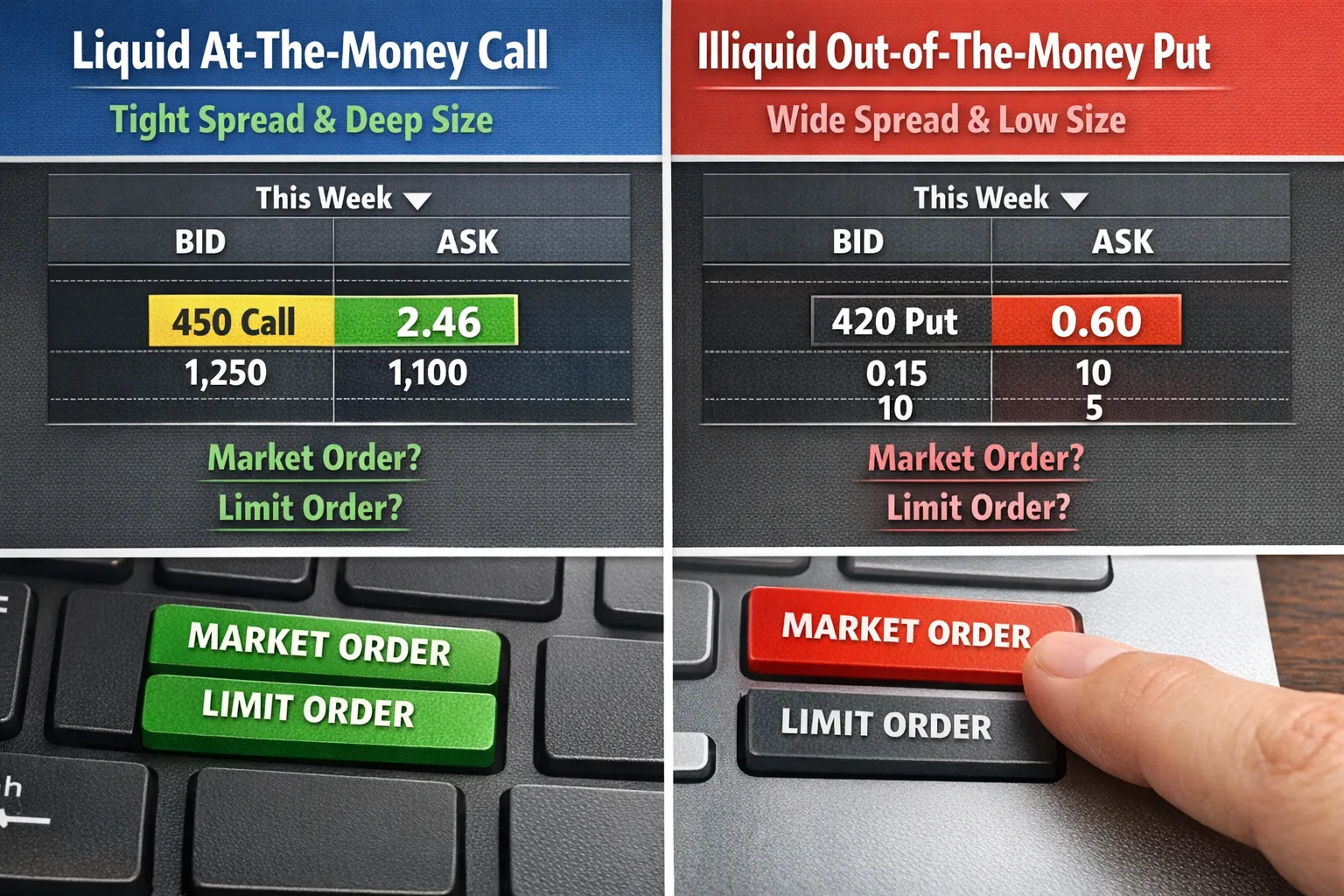
A split-screen options chain: left side shows a highly liquid at-the-money weekly call with a 0.01 spread and deep size, right side shows an illiquid out-of-the-money weekly put with a 0.45 spread and shallow size. The image highlights how spread width and depth influence the choice between market and limit orders.

IBKR users, practical execution notes

  • Understand displayed depth versus true liquidity. A market order can sweep multiple levels if your size exceeds inside size.
  • Be careful with pure market orders in thin options. Brokers and venues can cap prices or route for protection, but you are still exposed to poor prints when quotes are wide.
  • Review Interactive Brokers’ order type documentation for exact behavior and protections on your account and region. Platform defaults and price caps can vary.

For foundational trading literacy, see the SEC’s investor guidance on trade execution and costs: https://www.investor.gov/

How NeonChainX helps you choose and execute the right order fast

NeonChainX is built for speed and clarity when trading options through Interactive Brokers.

  • Instant multi‑chain view, scan multiple strikes and expirations in one clean layout so you can quickly pick the most liquid contract that supports a fast market order when it makes sense.
  • One‑click TP/SL automation, predefine exits by price and order type, Market, Bid/Ask, or Mid, then let rules fire without hesitation.
  • Low‑latency execution with direct IBKR integration, shave reaction time when the decision is made.
  • Live risk tracking and real‑time P&L monitoring, see the impact of fills and adjustments as they happen.
  • Rule‑based order triggers and visual spread clarity, codify your execution rules and spot when spreads are too wide for market orders.
  • Symbol memory restore, reopen the app and pick up right where you left, with the same chains ready.

If you are new to the platform, start here, Getting Started with NeonChainX. For an overview of the product vision and core benefits, read Welcome to NeonChainX.

A quick decision checklist for each trade

  • How tight is the spread relative to the option price, and how deep is the inside size?
  • Is the trade an urgent exit or hedge where opportunity cost dominates slippage?
  • Are you trading a single leg or a multi‑leg strategy that needs a net price?
  • What is your size relative to displayed liquidity?
  • Can a marketable limit cap worst‑case slippage while keeping high fill odds?
  • Do you have TP and SL rules pre‑staged so your plan executes automatically?

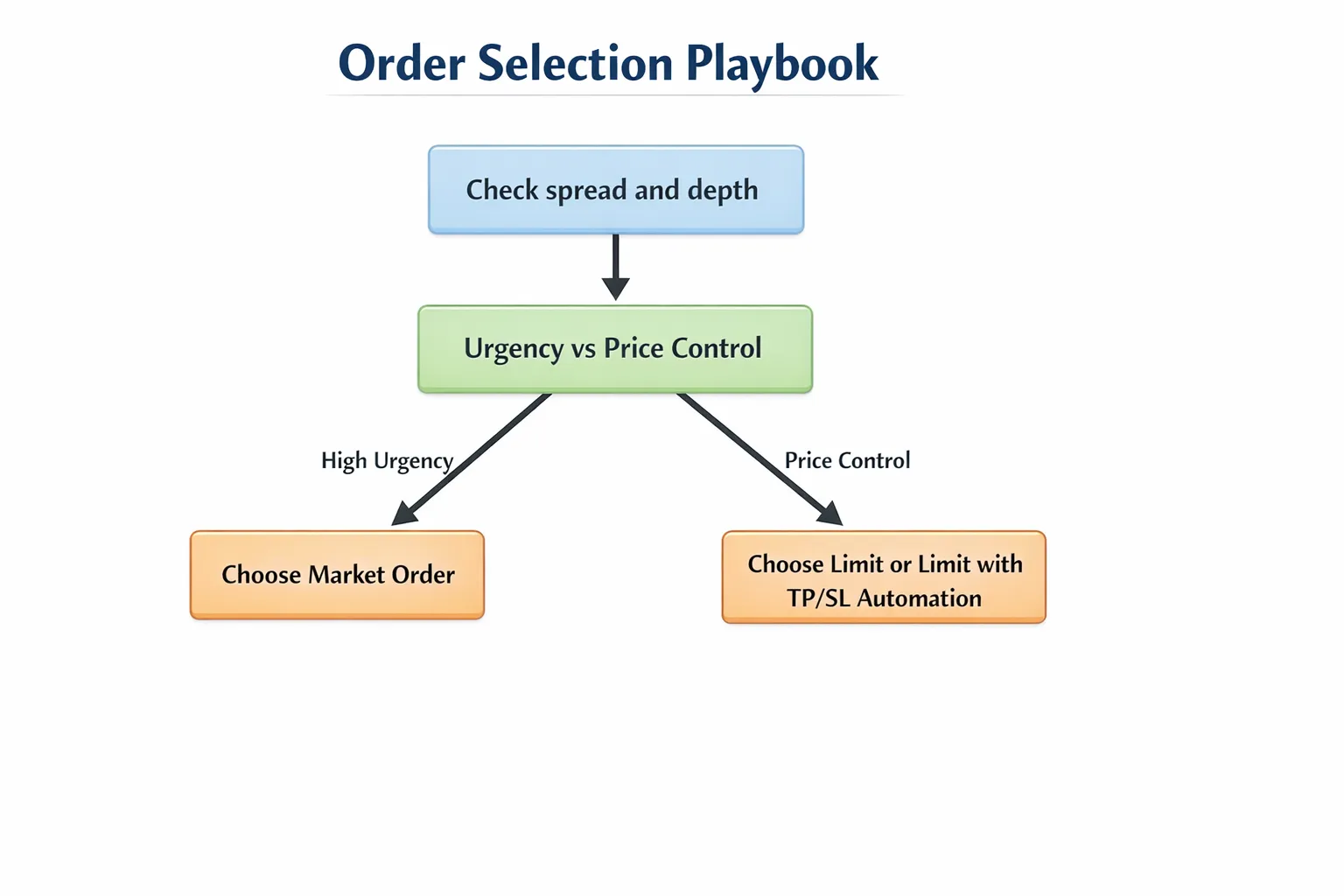
A minimal decision flow diagram titled “Order Selection Playbook,” showing three boxes: (1) Check spread and depth, (2) Urgency vs price control, (3) Choose Market, Marketable Limit, or Limit with TP/SL automation.

Bottom line

Market orders are tools for certainty and speed. Limit orders are tools for price and control. In highly liquid options and urgent situations, speed often wins. In illiquid chains, multi‑leg trades, and around the open, control wins. The best traders blend both, leaning on marketable limit tactics and automation to protect edge.

NeonChainX gives you the fast interface and rule‑based tools to execute that playbook on Interactive Brokers, without the clutter that slows you down. If speed is part of your edge, put it to work with a platform built for it.

Important risk note, Options involve risk and are not suitable for all investors. Read the OCC’s Characteristics and Risks of Standardized Options before trading.