Interactive Brokers Brokerage Fees: Simple Breakdown
Featured image: Interactive Brokers Brokerage Fees: Simple Breakdown
Brokerage fees are one of the few parts of trading you can measure precisely, and for active options trading they compound fast. If you trade intraday, scalp, or run high-frequency adjustment cycles, the difference between a “cheap” and “expensive” setup is rarely just the headline commission. With Interactive Brokers (IBKR), your total cost is usually a mix of per-contract commissions, exchange and regulatory pass-through fees, market data subscriptions, and sometimes financing (margin interest).
This guide gives a simple, practical breakdown of Interactive Brokers brokerage fees, specifically through the lens of IBKR options trading.
The simple model: what you pay on IBKR
For most US-listed options trades at Interactive Brokers, your “all-in” cost typically falls into three buckets:
1) Trading costs (per order)
These are costs that occur when you place and fill an order:
- Commission (IBKR’s per-contract pricing)
- Exchange, clearing, and regulatory fees (often pass-through, and can vary by venue and whether you add or remove liquidity)
2) Data costs (per month)
These are costs to see quotes and build a reliable options chain view:
- Market data subscriptions (for example, US options quotes via OPRA)
3) Financing costs (when applicable)
These show up if you borrow money or borrow stock:
- Margin interest (if you hold positions on margin and borrow cash)
- Stock borrow fees (if you short stock, including as part of some hedges)
IBKR publishes its official pricing schedules and fee explanations on its site. The best starting points are its pages for commissions, other fees, and margin rates. (Exact costs vary by product, exchange, and account configuration, so always confirm your schedule.)
IBKR options commissions: what actually determines the number
When traders talk about “IBKR fees,” they usually mean the options commission. But IBKR’s options cost is not one fixed number for everyone. It depends mainly on these factors:
Fixed vs Tiered pricing
IBKR generally offers different commission structures (commonly referred to as Fixed and Tiered in many regions/products). In plain English:
- Fixed: simpler and more predictable per contract pricing
- Tiered: commission can be lower, but you typically see more variation because more exchange and regulatory components are passed through explicitly
For active traders, the important point is not which is “cheaper” in general, but which is cheaper for your reality: your contract size, the products you trade, and how often you provide liquidity vs take liquidity.
Contract count and multi-leg strategies
Options commission is usually per contract, which means:
- Trading 1 contract is not the same as trading 10 contracts
- A 4-leg strategy (iron condor, butterfly, etc.) is effectively multiple option orders under the hood, so commissions scale with the total contracts across legs
Even if you trade “one spread,” your fees are often tied to total contracts executed.
Product and exchange nuances
Index options vs equity options, different exchanges, and routing choices can change the exchange-related portion of costs. IBKR’s commission schedule and the pass-through fees do the heavy lifting here, so you want to understand the structure rather than memorize numbers.
Pass-through fees: why two traders can pay different amounts on the same trade
Beyond commission, many traders notice that the fee line item varies from fill to fill. That is often because exchange-related fees can depend on execution details.
Common pass-through categories (conceptually)
While IBKR’s statement line items can vary by product, many options traders will see variations driven by:
- Exchange fees: fees charged by the venue where the order executes
- Clearing fees: fees related to the clearing process
- Regulatory fees: small per-transaction fees charged by regulators (more commonly obvious on equities, but still part of the broader “all-in” cost picture)
- Liquidity effects: in some markets, adding liquidity vs taking liquidity can change exchange fees (and in some cases create rebates)
The practical takeaway is that “commission” is only the base layer. If you’re cost-auditing an options trading platform setup, you should audit fills and look at the combined total.
A simple table: the fee components options traders should track
Use this as a checklist when you review your Activity Statement or trade confirmations.
| Fee component | When it appears | What makes it change | Why it matters for active options trading |
|---|---|---|---|
| IBKR commission | On each fill | Pricing plan (Fixed/Tiered), contracts, product | Predictable base cost, scales with volume |
| Exchange and clearing fees | On many fills | Exchange, routing, liquidity (add/take), product | Explains why costs vary trade to trade |
| Market data subscriptions | Monthly | Subscriptions selected, professional status | Impacts your ability to see reliable quotes and fast chain updates |
| Margin interest | Daily while borrowing | Rates, borrowed amount, time held | Quietly becomes a big cost for levered positions |
| Stock borrow fees | While short stock | Borrow availability, rate, time held | Matters for stock hedges and short positions |
The “hidden” costs around IBKR options trading (that matter in 2026)
Market data: paying for the right options quotes
If you trade US options actively, you typically need live options quotes (commonly via OPRA) to avoid trading off stale data. Even if you use a fast interface, your decisions are only as good as your feed.
If your workflow depends on quickly scanning strikes and expirations (especially in fast markets), treat market data as part of the core cost of doing business, not an optional add-on.
Margin interest: the fee you do not notice until you do
Margin interest is not an “options fee,” but it becomes part of your total P&L if you carry positions and borrow cash. It can also matter when you:
- hold deep ITM options positions that behave like synthetic stock
- carry hedges overnight
- run portfolio margin with meaningful leverage
IBKR publishes benchmark-based margin rate schedules on its margin rates page. The right question to ask is: “How many days am I typically borrowing, and how much?”
Short stock borrow fees (if you hedge with stock)
Some options traders hedge delta with shares or run strategies that temporarily short stock. Borrow fees can vary widely depending on availability. If you do this frequently, it belongs in your cost model.
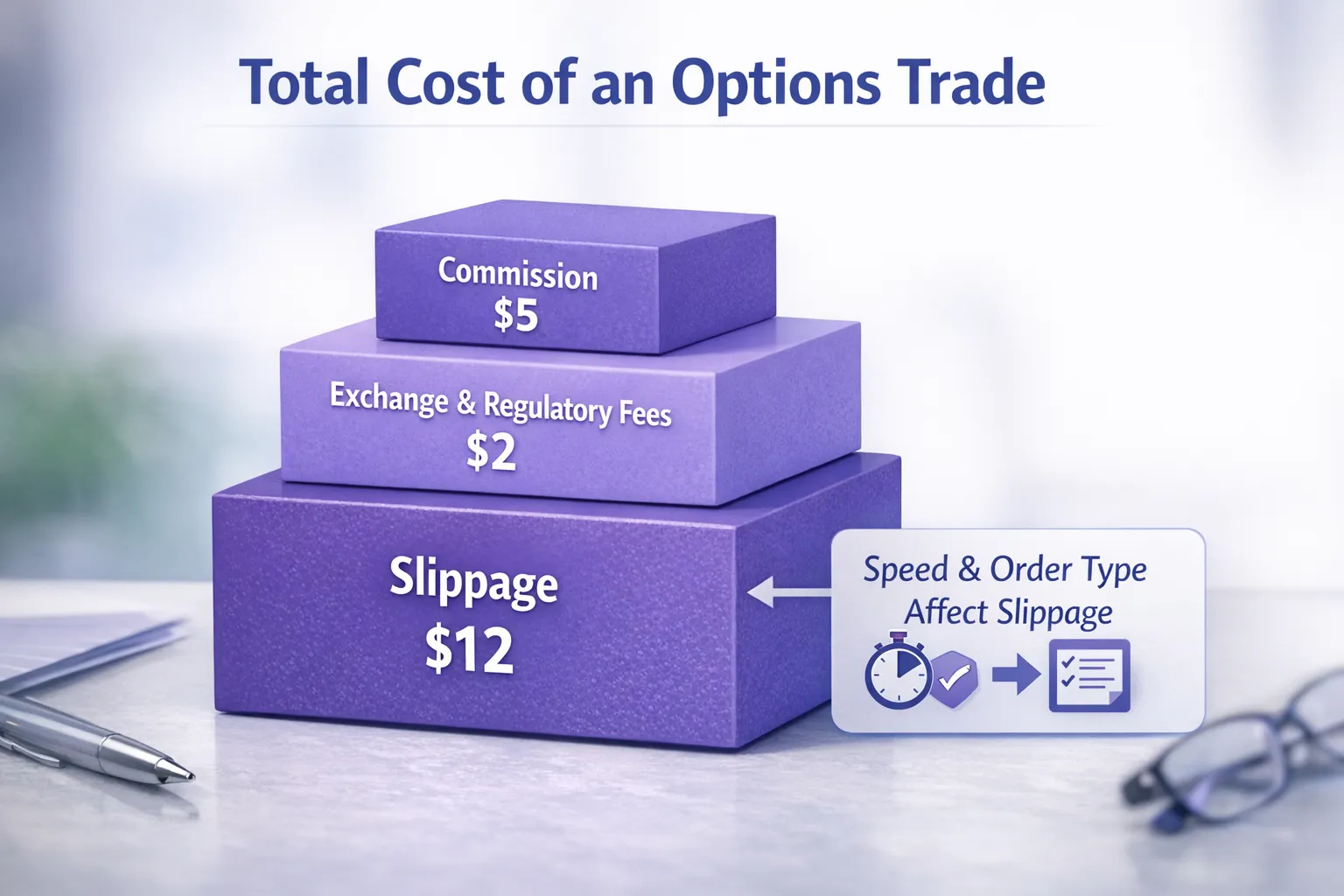
Platform-driven costs: slippage and missed fills
This is the cost many traders underestimate because it is not labeled “fees.” In fast tape conditions, slow execution workflows can increase:
- slippage (paying worse prices)
- missed entries/exits (opportunity cost)
- execution inconsistency (fill quality variance)
These costs are why “cheap commissions” can still lead to expensive trading.
How to estimate your true “all-in” cost per options trade
For most active traders, you want an estimate you can calculate quickly and compare across strategies.
A practical formula
For a single-leg trade:
All-in cost (one side) ≈ (contracts × your per-contract commission) + exchange and clearing fees
For a round trip (entry + exit):
All-in cost (round trip) ≈ 2 × (one-side cost)
For multi-leg spreads, use total contracts across all legs.
Why this matters for scalpers
If your average profit target is small (for example, a few cents to a few dimes in option premium), fees and micro-slippage can dominate outcomes. A strategy that “works on paper” often fails after:
- per-contract costs
- exchange fee variability
- partial fills
- slippage during fast moves
If you are a high-turnover trader, build your backtests and journaling around net results after realistic per-contract and per-fill assumptions.
Where to see IBKR fees (and verify you are not guessing)
If you want a clean audit trail, rely on IBKR’s own reporting rather than memory.
In IBKR statements and confirmations
Look for:
- Trade confirmations (per-fill detail)
- Activity Statements (daily/monthly summaries)
These are the fastest way to answer: “What did I actually pay per contract on average last month?”
In your order workflow
Many traders also check estimated commissions/fees during order entry (depending on the interface they use). The goal is not to obsess over pennies, but to catch:
- incorrect assumptions about pricing plan
- unexpectedly high costs on certain products
- differences between liquidity-taking vs liquidity-providing behavior
How to reduce Interactive Brokers brokerage fees (without trading worse)
Cost reduction is useful only if it does not create bigger losses through worse execution. The best optimizations tend to be structural.
Choose the pricing structure that matches your behavior
If you trade frequently, it is worth comparing Fixed vs Tiered based on your real fills. One month of actual data is usually more useful than theory.
Use order types that control slippage without killing fill probability
For options trading with low latency, many active traders prefer “marketable” limits (a limit price set aggressively enough to fill) to balance speed and price control. Your ideal approach depends on liquidity, spread width, and urgency.
If you want a deeper execution playbook, NeonChainX covers the speed vs price tradeoff in Market Order vs Limit: When Speed Wins.
Treat platform speed as a cost lever
A faster workflow can reduce total cost even if commissions are unchanged, because you can:
- enter/exit with fewer clicks (less decision friction)
- react faster to changes in spread width
- avoid re-quotes and hesitation in fast conditions
This is exactly where a fast options trading platform for Interactive Brokers can matter. NeonChainX is built specifically for IBKR users and focuses on low-latency execution, a multi-chain options view, and one-click automated TP/SL for options. The point is not “more features,” it is fewer delays between seeing the opportunity and placing the order.
For a practical guide to reducing execution latency end-to-end, see Trading Execution: Cut Latency, Fill Faster.
A quick reality check: what “cheap” means for professional options traders
For professional and semi-professional traders, “cheap” is usually not the lowest advertised commission. It is:
- low and predictable all-in costs per contract
- minimal slippage relative to the spread
- reliable fills during volatility
- clean reporting you can audit
Interactive Brokers is popular with active traders because its pricing and infrastructure are designed for serious trading, but you still need to understand how the parts add up.
Putting it together
If you remember only one thing about Interactive Brokers brokerage fees, make it this: your true cost is the combination of commission, pass-through fees, data, financing, and execution quality. Options traders who measure and optimize all five tend to outperform traders who only compare brokers by the headline per-contract rate.
If you trade IBKR options actively and care about low latency options execution, pairing IBKR’s infrastructure with a purpose-built, options-first interface (like NeonChainX) can help you reduce the “unlabeled fees” of trading: wasted time, missed fills, and slippage that quietly exceeds commissions.