Real Time Trading Platform: Must-Have Features
Featured image: Real Time Trading Platform: Must-Have Features
Speed is not a nice-to-have in active trading, it is part of your edge. In fast options markets, the difference between a fill at mid and a fill at the ask can be the difference between a green day and death by a thousand cuts. That is why choosing a real time trading platform is less about “does it have charts?” and more about whether it can keep your market view, order actions, and risk picture synchronized while the tape is moving.
Below are the must-have features to look for, specifically through the lens of options traders, day traders, and scalpers (especially if you route through Interactive Brokers).
What “real time” should mean in a trading platform
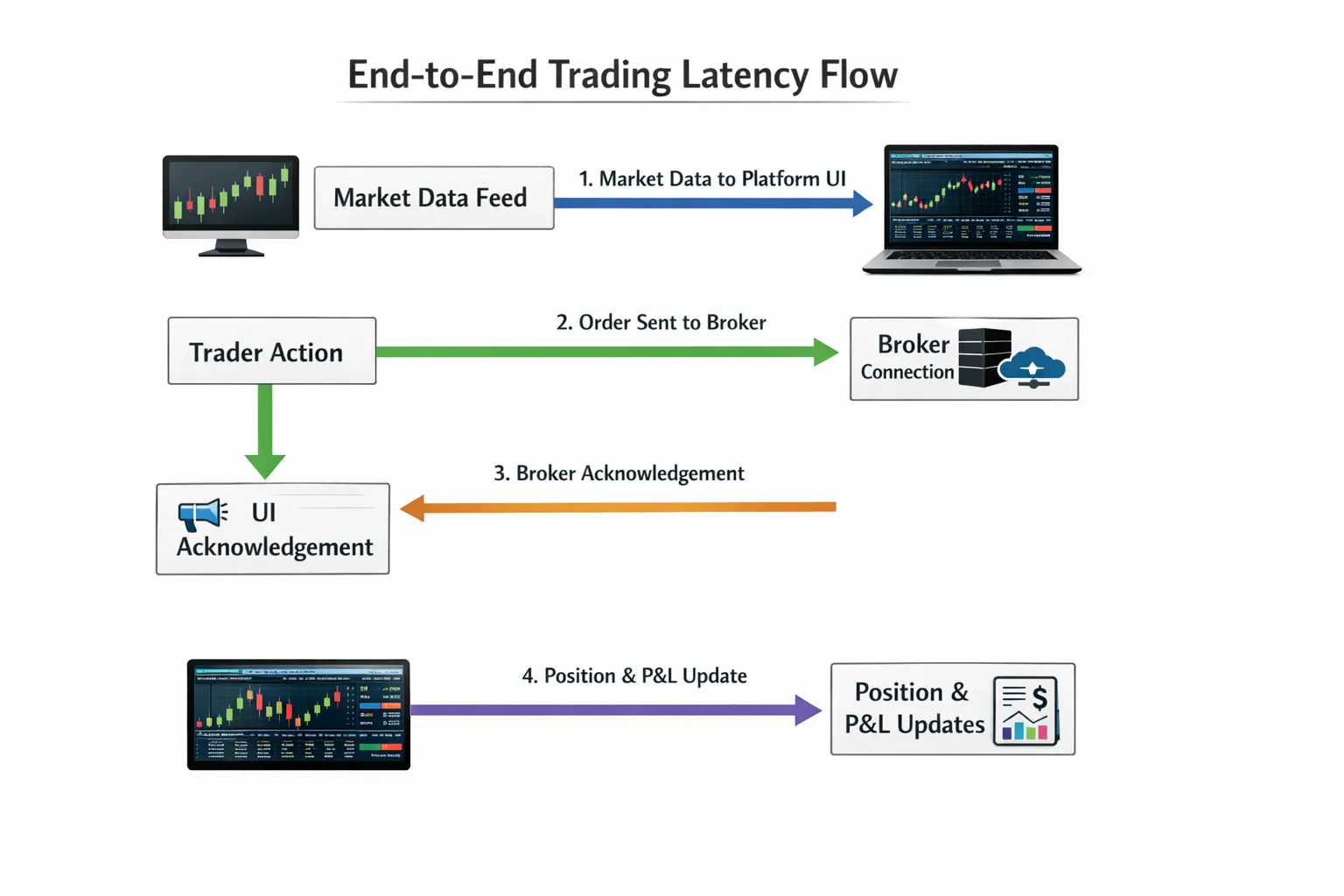
Most platforms claim to be real time. In practice, “real time” breaks down into three separate systems that must stay aligned:
- Market data freshness: how quickly quotes, trades, Greeks, and IV update from the venue or broker feed.
- Action latency: how quickly your clicks and hotkeys become live orders at the broker.
- State accuracy: how quickly fills, partial fills, position size, average price, and P&L update back into your interface.
If any one of those lags, you get the classic failure modes: chasing stale quotes, double-submitting, exiting late, or managing risk off the wrong size.
A helpful way to think about it is end-to-end latency, not “my broker is fast” or “my UI is smooth.”
| Real-time component | What it affects | Typical failure symptom |
|---|---|---|
| Quote and chain update speed | Entries, exits, spread pricing | You lift offers that no longer exist |
| UI render and interaction speed | Scalping, rolling, rapid adjustments | You hesitate because the interface fights you |
| Order transmission and acknowledgements | Slippage, missed fills | Orders show “pending” during fast moves |
| Position and P&L refresh | Risk control, stop logic, sizing | You manage off stale size or stale delta |
Must-have features in a real time trading platform (for active options traders)
1) Low-latency execution and responsive order management
“Execution speed” is not just the broker route, it is also how quickly you can:
- Place orders without modal popups and extra steps
- Modify orders (cancel/replace) without delays
- See acknowledgements and rejections immediately
- Confirm working orders and actual fills in a way you cannot misread
For scalpers, cancel/replace reliability is a core feature. If you cannot confidently yank a resting order when the market turns, you will trade smaller than you want, or worse, you will get filled when you no longer want the position.
What to look for:
- Fast, unambiguous order state changes (submitted, working, partial, filled, canceled)
- Rapid cancel-all and cancel-by-symbol controls (especially useful during volatility spikes)
- Support for bracket-style workflows (take-profit and stop-loss logic) when appropriate for your strategy
2) A true options chain optimized for speed (not just “data-dense”)
Options trading punishes clutter. A good platform can be information-rich while still being scannable.
Must-have chain capabilities for active traders:
- Fast chain scrolling and strike navigation without freezes
- Clear bid/ask, last, and size, plus Greeks where relevant
- Visual spread clarity so you can see what is wide, what is liquid, and where the “air pockets” are
- Rapid switching between expirations and strikes without losing context
For many options traders, the chain is the product. If it is slow, everything is slow.
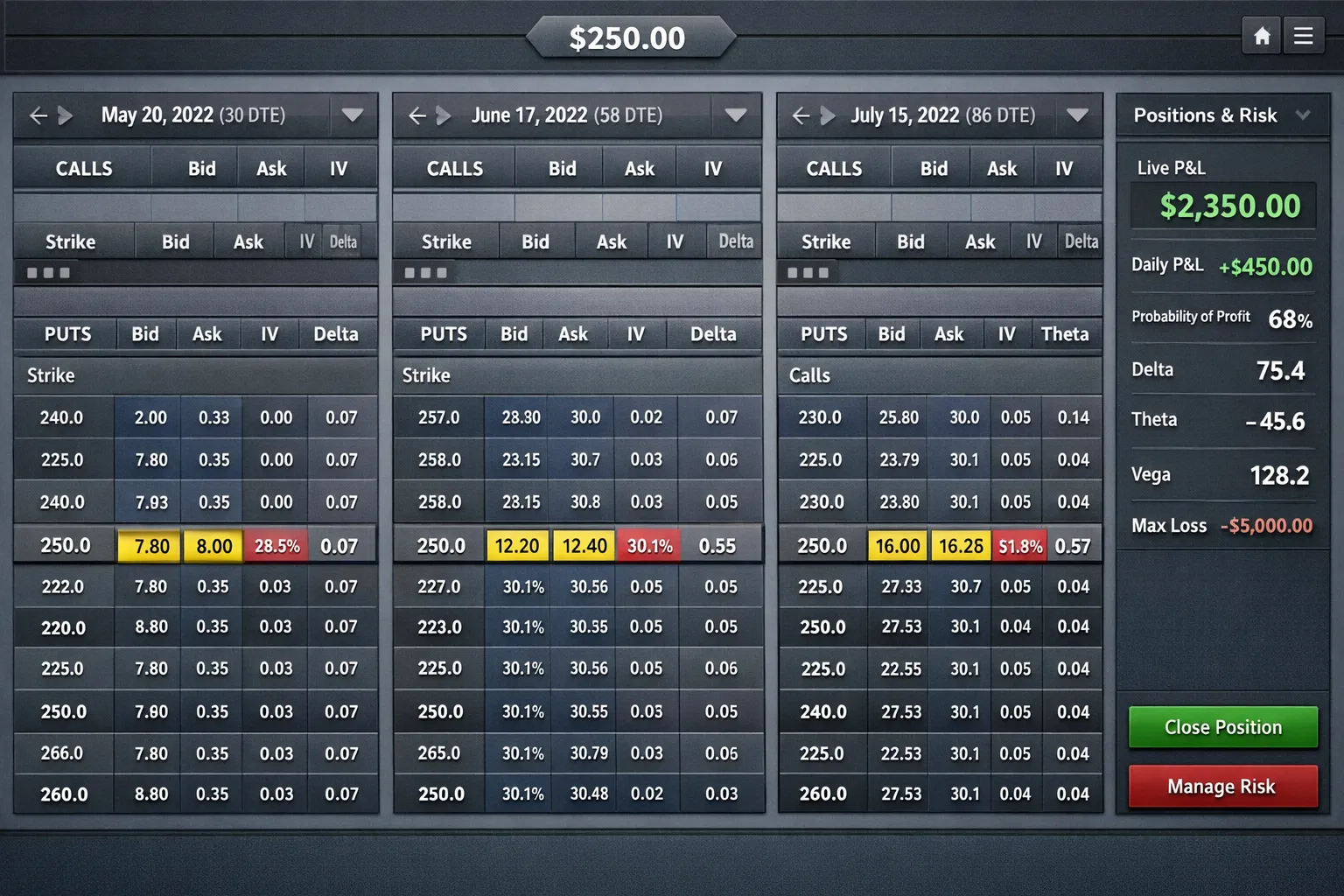
3) Instant multi-chain view (critical for comparison and decision speed)
If you trade actively, you often need to compare:
- Different expirations for the same underlying
- Multiple underlyings in the same theme (index, sector, correlated names)
- Different structures (for example, comparing where liquidity concentrates)
A platform that forces you into one chain at a time adds friction. A multi-chain view removes tab switching and lets you make faster, more confident decisions.
This is especially valuable when you are:
- Rolling positions under time pressure
- Hunting a specific risk profile across expirations
- Looking for the cleanest spreads and best fills for the same thesis
4) One-click TP/SL automation (and the ability to manage it live)
Take-profit and stop-loss logic is not only about discipline, it is also about reducing reaction time.
For active options traders, the best implementations share two traits:
- Fast to place (ideally one click from the position view)
- Easy to adjust as the trade evolves (tighten stops, scale out, update targets)
You want automation that fits reality: partial fills happen, spreads widen, and the best exit might be mid one moment and bid the next. Look for configurable order types (market, bid/ask, mid, as your approach requires) and clear indicators that the rule is armed and tracking.
5) Live risk tracking that updates with fills, not with hope
“Real time” risk means your risk view changes immediately when:
- You get a partial fill
- You add or reduce a leg
- Your broker adjusts margin requirements
- Volatility changes and your Greeks move
At minimum, your platform should keep real-time P&L monitoring and position size accurate and visible. For options, traders often also want quick access to directional exposure and how the position behaves if price moves.
There is also a compliance angle here: broker-dealers that provide market access must maintain risk controls and supervisory procedures under SEC Rule 15c3-5 (the “Market Access Rule”). Even if you are trading your own account, the spirit is the same: your tooling should help prevent unbounded mistakes, not amplify them. (Primary source: SEC Release 34-63241.)
6) Rule-based order triggers (automation for repeatable tactics)
Scalpers and systematic day traders often repeat the same patterns:
- “If price hits X, take partial.”
- “If position P&L hits Y, flatten.”
- “If underlying breaks a level, send a hedge.”
Rule-based triggers can reduce cognitive load and prevent the “I saw it but I was late” problem. The must-have here is transparency: you need to see what rules are active, what they will do, and how to disable them instantly.
7) Symbol memory restore and fast session recovery
Real trading days include disconnects, restarts, and context switching. A professional-grade real-time platform should help you recover your workspace quickly:
- Restoring your watched symbols and working context
- Reconnecting without requiring a full rebuild of your layout
- Keeping your view aligned with the broker’s actual positions and orders
This matters more than people admit because many expensive mistakes happen right after a reconnect, when a trader assumes the platform view matches the broker state.
8) Direct broker integration (especially for IBKR users)
If you trade through Interactive Brokers, the integration details matter:
- How stable the connection is to TWS or IB Gateway
- How quickly order updates and position updates propagate
- How well the platform reflects IBKR’s order statuses and partial fills
A “real time trading platform” for IBKR users should feel like an extension of the broker connection, not a separate tool that periodically catches up.
(If you want to understand IBKR’s official interfaces, Interactive Brokers maintains an overview of its APIs and connectivity options on its site: Interactive Brokers API.)
9) A clean interface that reduces micro-decisions
Speed is also cognitive. An active trader spends all day making small decisions. A good platform reduces unnecessary choices:
- Clear, consistent colors and spacing that highlight what matters (spread width, liquidity, position state)
- Minimal friction for common actions (close, roll, adjust)
- A layout that keeps chain, orders, and portfolio visible without burying key information
This is where “fast” becomes more than latency. A clean interface is a risk-control tool because it reduces misclicks and misreads.
A useful analogy: real-time trading systems vs “plug-and-play” stacks
In 2025, many industries have moved toward modular, real-time stacks where critical layers (payments, compliance, identity, messaging) are treated as first-class components, not afterthoughts. Travel is a good example: modern travel operators increasingly treat visa and regulatory compliance as a core layer because it directly impacts conversion and support load. If you are interested in how that “plug-and-play” mindset is shaping tech stacks outside finance, this overview of the plug-and-play travel tech stack is a useful read.
Trading is similar: the “stack” (data, execution, risk, automation, recovery) is only as strong as its weakest real-time component.
How to evaluate a real time trading platform (a practical test)
Demos can look great in slow markets. You want to test the platform under the conditions you actually trade.
Run a speed and stability checklist
Use this table as a simple evaluation framework.
| Feature to verify | Why it matters for options day trading | How to test it (practically) |
|---|---|---|
| Quote and chain refresh speed | Prevents chasing stale prices | Watch a liquid chain during a fast move, verify updates feel continuous |
| Multi-chain navigation | Cuts time-to-decision | Switch expirations and compare chains without UI lag |
| Order entry and cancel/replace speed | Reduces slippage and “stuck orders” | Place, modify, cancel rapidly in paper trading, watch acknowledgement speed |
| Real-time position and P&L updates | Avoids managing off wrong size | Intentionally create partial fills (if possible), verify size and P&L update immediately |
| TP/SL automation controls | Enforces exits without hesitation | Attach TP/SL to a position, then adjust it live, verify the change is reflected |
| Rule visibility and safety | Prevents surprise automation | Confirm you can see active rules and disable them fast |
| Reconnect behavior | Protects you after a disconnect | Restart the app (or drop connection), verify positions/orders sync correctly |
Watch for hidden “latency traps”
Even if a platform is fast most of the time, these are common pain points:
- Chain updates freeze when you open too many windows
- Order status lags behind fills (you think you are flat, you are not)
- The UI is fast, but you must click through confirmations for every action
Where NeonChainX fits for IBKR options traders
If your primary need is a fast, desktop-first options workflow on Interactive Brokers, NeonChainX is built around the exact “must-haves” active traders tend to care about:
- Instant multi-chain view for rapid comparison
- One-click TP/SL automation for faster, more consistent exits
- Low-latency execution through direct IBKR integration
- Live risk tracking and real-time P&L monitoring
- Rule-based order triggers and symbol memory restore for workflow continuity
- Visual spread clarity in a clean, speed-focused interface
If you are evaluating platforms, the best next step is not to memorize feature lists, it is to run your own workflow tests: the symbols you trade, the hours you trade, and the market conditions that usually stress your process.
Frequently Asked Questions
What is a real time trading platform? A real time trading platform is software that keeps market data, order actions, and account state (orders, fills, positions, P&L) updated with minimal delay, so what you see is aligned with what is actually happening at your broker and in the market.
Why do options traders care more about “real time” than investors? Options pricing can change quickly because it is sensitive to the underlying price, implied volatility, and time. When you are day trading or scalping, small delays can translate into worse fills, missed exits, and inaccurate risk management.
What features matter most for options scalpers? Low-latency order entry, rapid cancel/replace, a fast options chain, clear spreads, real-time position and P&L updates, and automation that helps you exit quickly (for example, TP/SL logic).
Is a desktop trading platform faster than a web platform? Not always, but native desktop apps often have advantages in responsiveness, multi-window workflows, and consistent performance under load. The real determinant is the full pipeline: data handling, UI rendering, broker connectivity, and order management.
How can I test platform speed without risking money? Use paper trading and focus on responsiveness during active market windows. Measure how quickly quotes update, how quickly orders are acknowledged, and how accurately positions and P&L reflect fills.
Do I need automation like TP/SL rules if I trade manually? Many manual traders still benefit from automation because it reduces reaction time and decision fatigue. The key is using automation that is transparent, adjustable, and easy to disable.
Try a speed-focused options workflow on Interactive Brokers
If you are an IBKR user and you want a real-time interface designed for fast options execution, explore NeonChainX at NeonChainX. Focus your evaluation on the moments that usually cost you money: rapid chain navigation, fast order changes, and exits under pressure.